
PRFCT x Whitmores Native Plant List
Perfect Earth Project teamed up with Whitmores Tree Farm to help you grow your East End yard. Here is a list of Whitmores-selected, PRFCT recommended native trees, shrubs, grasses, and perennials available at their East Hampton, NY, nursery. Ready to start planting? Find our planting advice here.
Trees & Shrubs
- Red Maple (Acer rubrum)
- Seed-grown Red Maple (Acer rubrum) “I love everything seed grown because it provides genetic diversity, except of course invasive plants!” —Edwina von Gal
- Bottlebrush buckeye (Aesculus parviflora)
- Red buckeye (Aesculus pavia)
- Shadblow Serviceberry (Amelanchier canadensis) “This is a great companion for wildlife. Cedar Waxwings love the berries!” —EvG
- Allegheny serviceberry (Amelanchier laevis) “The dark berries are tasty to wildlife—and humans!”
- ‘Iroquois Beauty’ chokeberry (Aronia ‘Iroquois Beauty’)
- Common pawpaw (Asimina triloba) “The fall-bearing fruit is absolutely delicious and the tree is an exclusive host plant of the zebra swallowtail butterfly.”
- Groundseltree (Baccharis halimifolia)
- River birch (Betula nigra)
- American beautyberry (Callicarpa americana)
- Carolina allspice or Eastern sweetshrub (Calycanthus floridus)
- ‘Athens’ sweetshrub (Calycanthus floridus ‘Athens’)
- Shagbark hickory (Carya ovata)
- Northern catalpa (Catalpa speciosa) “Love this tree!” —EvG
- Hackberry (Celtis occidentalis)
- Eastern redbud (Cercis canadensis)
- White fringetree (Chionanthus virginicus)
- Kentucky yellowwood (Cladrastis kentukea)
- Summersweet (Clethra alnifolia) “The white flowers have an intoxicating spicy fragrance when it blooms in late summer.”
- Virigin’s-bower (Clematis virginiana)
- Flowering dogwood (Cornus florida)
- Cornus florida ‘Appalachian Spring’
- Red twig dogwood (Cornus sericea)
- American hazelnut (Corylus americana)
- Fothergilla ‘Mt. Airy’
- Honey locust (Gleditsia triacanthos)
- Kentucky coffeetree (Gymnocladus dioicus)
- Carolina silverbell (Halesia carolina)
- Oakleaf hydrangea (Hydrangea quercifolia)
- Compact inkberry (Ilex glabra ‘Compacta’) “The straight species can get leggy, so I prefer this cultivar.” —EvG
- Ilex glabra ‘Densa’
- Ilex glabra ‘Shamrock’
- Ilex glabra ‘Strongbox’ “If someone insists on boxwood, this is a good alternative” —EvG
- American holly (Ilex opaca) “Robins love the fruit!” —EvG
- Ilex opaca ‘Jersey Princess’
- Ilex opaca ‘Miss Helen’
- Ilex opaca ‘Patterson’
- ‘Winter Red’ winterberry (Ilex verticillata ‘Winter Red’)
- Yellow anisetree (Illicium parviflorum)
- Illicium × ‘Woodland Ruby’
- Eastern red cedar (Juniperus virginiana)
- Northern spicebush (Lindera benzoin) “The high-fat berries of spicebush ripen in fall just when migrating thrushes and tanagers are bulking up for their long journeys south.”
- ‘Moraine’ sweetgum (Liquidambar styraciflua ‘Moraine’)
- Tulip tree (Liriodendron tulipifera) “This is a great, but underutilized tree.” —EvG
- Cucumber tree (Magnolia acuminata)
- Southern magnolia (Magnolia grandiflora)
- Sweetbay magnolia (Magnolia virginiana)
- Magnolia virginiana ‘Green Mile’
- Magnolia virginiana ‘Green Shadow’
- Magnolia virginiana ‘Moonglow’
- Magnolia virginiana ‘Northern Belle’
- Holly-leaved barberry (Mahonia aquifolium)
- Northern bayberry (Myrica pensylvanica)
- Black tupelo (Nyssa sylvatica)
- American hop-hornbeam (Ostrya virginiana)
- Pitch pine (Pinus rigida)
- Eastern white pine (Pinus strobus)
- American sycamore (Platanus occidentalis)
- Black cherry (Prunus serotina)
- White oak (Quercus alba)
- Swamp white oak (Quercus bicolor)
- Shingle oak (Quercus imbricaria)
- Pin oak (Quercus palustris)
- Red oak (Quercus rubra)
- Black oak (Quercus velutina)
- Great laurel (Rhododendron maximum)
- Fragrant sumac (Rhus aromatica)
- Staghorn sumac (Rhus typhina)
- Sassafras albidum
- ‘Redmond’ linden (Tilia americana ‘Redmond’)
- ‘Jefferson’ elm (Ulmus americana ‘Jefferson’)
- ‘Princeton’ elm (Ulmus americana ‘Princeton’)
- Arrowwood vibernum (Viburnum dentatum)
- Nannyberry (Viburnum lentago)
- Viburnum nudum ‘Winterthur’
- Blackhaw (Viburnum prunifolium)
- American cranberry bush or highbush cranberry (Viburnum trilobum)
- Viburnum trilobum ‘Wentworth’
Perennials & Grasses
- Yarrow (Achillea millefolium) “This is super attractive to pollinators and it is deer resistant!” —EvG
- Butterfly weed (Asclepias tuberosa) “A host plant for monarch butterflies”
- Blue wild indigo (Baptisia australis)
- Swamp rose mallow (Hibiscus moscheutos) “This beauty needs moisture.” —EvG
- Cardinal flower (Lobelia cardinalis) “A favorite of Ruby-throated hummingbirds, this red-flowered perennial does best in moist soil.”
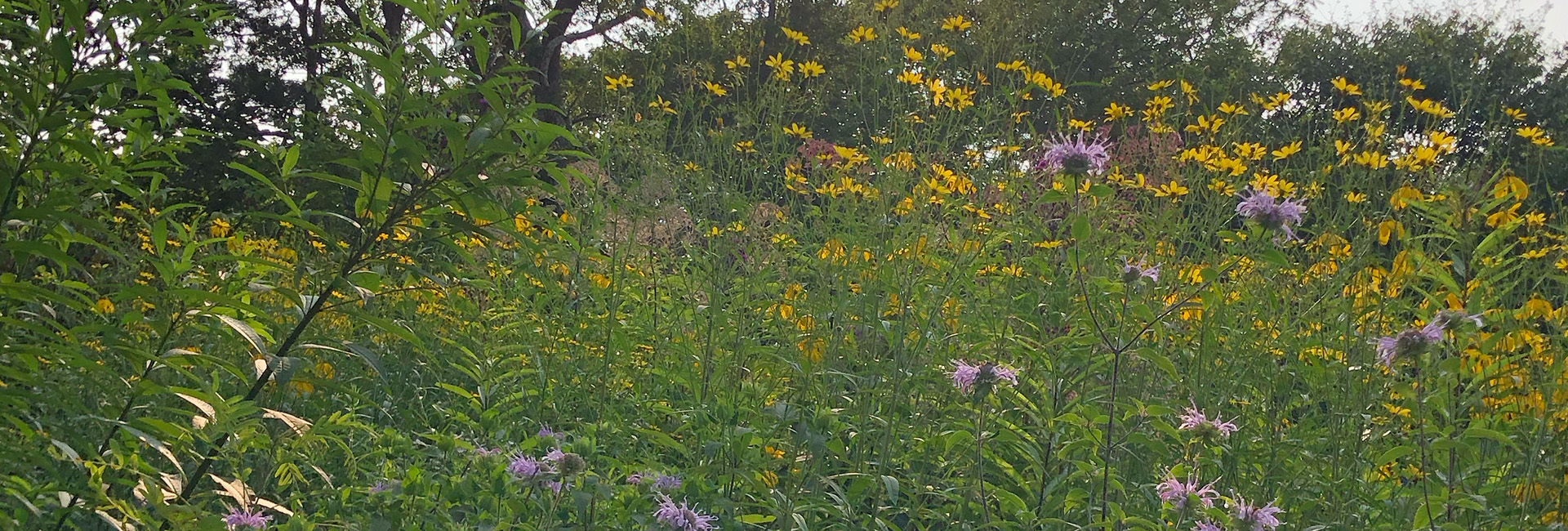
- Wild bergamot (Monarda fistulosa)
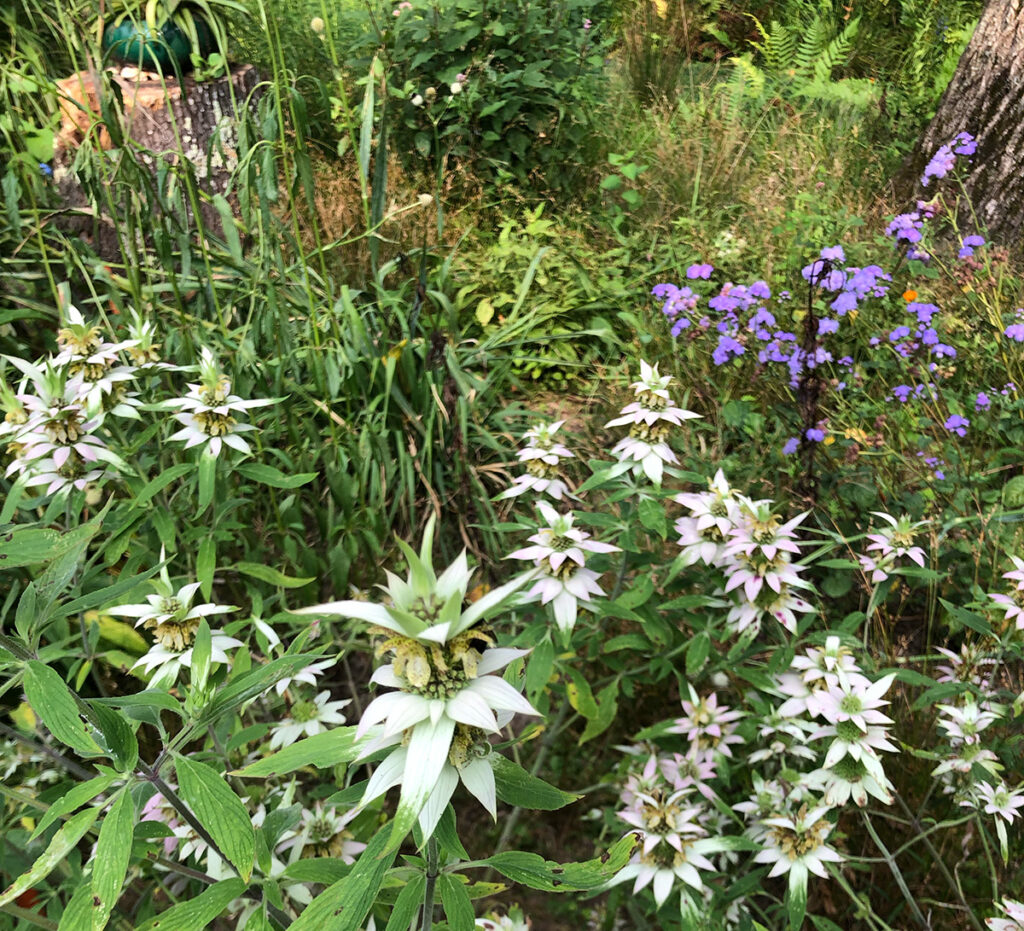
- Spotted beebalm (Monarda punctata)
- Smooth Solomon’s seal (Polygonatum biflorum) “A wonderful, slow-growing perennial” —EvG
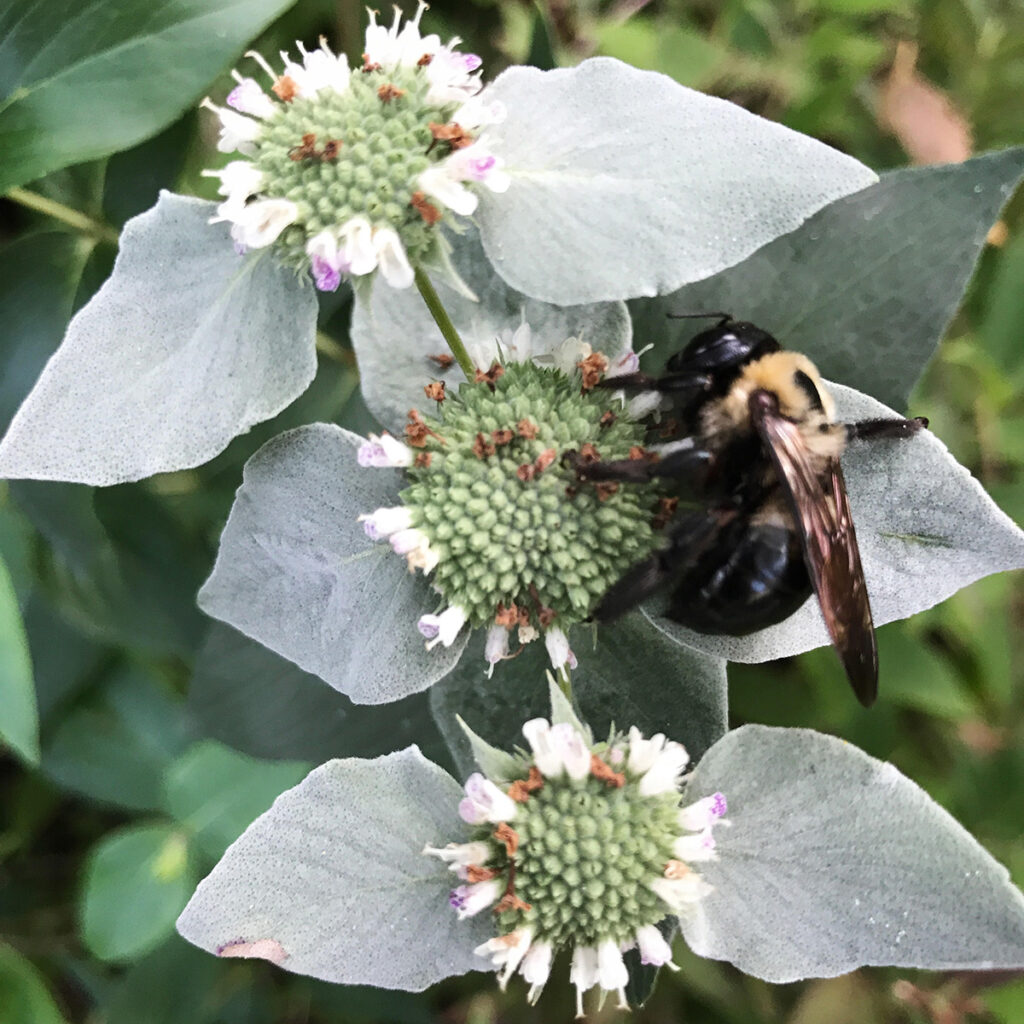
- Mountain mint (Pycnanthemum)
- ‘Green Wizard’ coneflower (Rudbeckia occidentalis ‘Green Wizard’)
- Compass plant (Silphium laciniatum)
- Slimstem reed grass (Calamagrostis stricta)
- Pennsylvania sedge (Carex pensylvanica)
- Fox sedge (Carex vulpinoidea)
- Tufted hair grass (Deschampsia cespitosa)
- Purple love grass (Eragrostis spectabilis)
- Sand love grass (Eragrostis trichodes)
- Muhly grass (Muhlenbergia capillaris)
- Prairie dropseed (Sporobolus heterolepis)
Now let’s start planting. Click here to learn more.