
PRFCT Glossary of Ecological Terms
Know the lingo! Here’s a list of key vocabulary that will help you understand and communicate important concepts of ecological land care. (Note: this is a living document. We always welcome feedback. Please email info@perfectearthproject.org.)
A
- Active Ingredient
The part of a product that actually does the intended biological work. - Aeration
The process of loosening or perforating soil so air, water, and roots can move through it more easily. - Annual Plant
A plant that completes its full life cycle—from seed to flower to seed again—in one growing season. - Allelopathy
When a plant releases chemicals that influence the growth, survival, or germination of nearby plants.
- Aquifer
An underground layer of permeable rock, sand, or sediment that stores and moves groundwater.
B
- Bare Ground
Exposed soil with little or no plant cover, mulch, or pavement. In the right places, bare ground can provide important nesting habitat for insects like native bees. - Beneficial Organisms
Living things that support ecosystem health, including soil bacteria, fungi, insects, and other organisms that break down organic matter, cycle nutrients, pollinate plants, or help keep pests in check. - Bee Beach
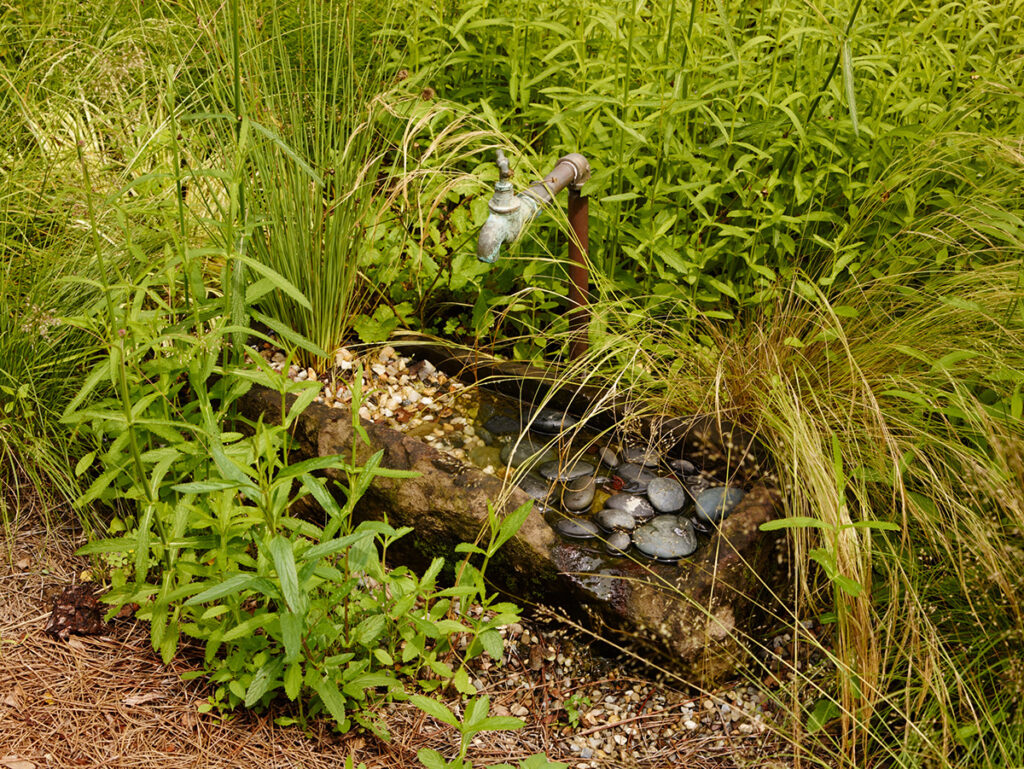
A shallow water feature designed so bees and other insects can drink safely. A bee beach usually includes a gently sloping edge or stones, sand, or pebbles that give insects a place to land while accessing water without drowning. Learn more about bee beaches and see some examples here.
- Biennial Plant
An herbaceous plant that completes its lifecycle in two years. - Bioassay
A test that uses living organisms or cells to measure the biological effect of a substance. - Biodiversity
The variety of life in a place—plants, animals, fungi, and microbes. More biodiversity usually means a healthier, more resilient ecosystem. Learn more here. - Biomass
All living (or recently living) organic material in a space, including plants, leaves, and soil organisms. Maintaining biomass supports soil health and ecosystem function. - Biome
A large ecological region, such as a forest, desert, or grassland, shaped by climate and dominant vegetation. - Biological Control
A natural process where beneficial organisms (like birds or predatory insects) keep pest populations in balance—reducing the need for pesticides. - Bioremediation
The use of plants, fungi, or microbes to help break down, absorb, or contain pollutants in soil or water. - Bioswale
A planted landscape feature designed to slow, capture, filter, and absorb stormwater runoff. - Bio-stimulants
Products or materials applied to plants or soil to improve vigor or stress tolerance, often by supporting biological processes rather than directly feeding the plant. - Blue-Green Algae
A common name for cyanobacteria. Some blooms can produce toxins that are harmful to people, pets, and wildlife. - Botanical Name
The two-part scientific name used to identify plants precisely includes the genus and species. Botanical names help avoid confusion caused by common names, which can vary by region. Cultivated plants at a nursery also carry a ‘cultivar name’. The genus name is capitalized and the species is written in lower case; both are italicized. Cultivars are written in roman type surrounded by single quotes. Ex. Itea virginica ‘Little Henry’ - Broadcast Sprays (Ticks)
Tick-control sprays applied over large areas, often containing chemicals like permethrin or bifenthrin that can also harm non-target species. - Buffer Strip
A planted strip of vegetation that helps slow runoff, reduce erosion, and filter pollutants before they reach a stream, road, lawn, or planting area.
C
- C:N Ratio
The carbon-to-nitrogen ratio in organic material, used to evaluate soil amendments and compost ingredients. - Canopy / Drip Line
The canopy is the upper layer of branches and leaves of a tree or shrub. The drip line is the ground area roughly under the outer edge of that canopy where rainwater drips off. - Carbon Sequestration
The process of capturing and storing carbon in plants, soils, and other natural systems instead of letting it remain in the atmosphere. - Carcinogens
Substances known to cause cancer. - Cavity-Nesting Bees
Bees that nest in holes or tunnels, such as hollow stems, dead wood, or beetle holes, like the eastern carpenter bee (Xylocopa virginica). - Certified Pesticide Applicator
A person trained and licensed to apply certain pesticides that are legally restricted due to their toxicity. - Chemical Control
Managing pests, diseases, or unwanted plants with chemicals such as herbicides, insecticides, or fungicides. - Climate-Resilient Landscape
A landscape designed to handle stresses like heat, drought, heavy rain, and shifting seasons while continuing to support people, plants, and wildlife. - Close the Loop
Keeping organic matter on-site—such as leaves, clippings, and plant debris—so it can return nutrients to the soil instead of becoming waste. Learn more here. - Community Science
Scientific observation and data collection done by members of the public, often in partnership with researchers or conservation groups. - Compaction
When soil has been pressed down by foot traffic, vehicles, or equipment, limiting air, water movement, and root growth. - Companion Planting
Planting species together that benefit each other—for example, improving pest resistance or soil health. - Compost
Decomposed organic material used to improve soil structure, fertility, and biological activity. Learn more here. - Compost Tea
A liquid made by steeping compost in water, sometimes used to introduce microbes and organic compounds to soil or plants. Learn more here. - Conservation
Protecting and restoring natural systems, species, and natural resources.
- Conventional Pesticide
A synthetic, human-made chemical used to kill or control pests. - Cover Crop
A plant grown mainly to protect and improve soil rather than for harvest. Cover crops can help reduce erosion, suppress weeds, and add organic matter. - Create Habitat
Designing and caring for landscapes so they actively support life, not just appearance. Download our Gardening for Habitat workbook. - Crown
The point where a plant’s roots and shoots meet. In turfgrass, it is the thick, whitish part at soil level where top growth and roots connect. - Cultivar
A plant variety selected or bred by people for certain traits, such as color, size, or disease resistance. - Cultural Practices
Routine gardening and land-care actions—like mowing, pruning, watering, mulching, and planting—that affect plant and soil health.
D
- Dappled Light
Light that comes through in a patchy or filtered way, such as sunlight shining through tree branches. - Deciduous
A plant, usually a tree or shrub, that drops its leaves seasonally each year. - Dicot
One of the two main groups of flowering plants, typically with two seed leaves and branching leaf veins. - Dioecious
A plant species with male and female flowers on separate plants. - Disturbance
A change or disruption in an ecosystem—such as fire, flooding, mowing, or construction—that affects how plants and animals live and grow.
E
- Ecological Function
The role something plays in keeping an ecosystem working—such as feeding wildlife, cycling nutrients, stabilizing soil, or filtering water. - Ecological Restoration
The process of helping a damaged or degraded ecosystem recover so it can function as a healthy natural system again. - Ecology
The study of how living things interact with each other and with their environment. - Ecological Gardening
See “Nature-based Gardening” - Ecoregion
A geographic area defined by shared climate, soil, water, and ecological communities. - Ecosystem
All the living and non-living things in a place interacting together—plants, animals, soil, water, air, and climate. - Ecosystem Services
Benefits provided by nature, such as pollination, water filtration, climate regulation, and soil formation. - Ecotype
A locally adapted population within a species that has adjusted over time to specific environmental conditions. - Edges / Edge Habitat
The transition zone where two different habitat types meet, such as forest and meadow. These areas often support a wide mix of species. - Endocrine Disruptors
Chemicals that interfere with hormone systems and can affect development, reproduction, immunity, and behavior. - Erosion
The wearing away and movement of soil by water, wind, or disturbance.
- Eutrophication
The process by which excess nutrients build up in a body of water, often leading to algal blooms and oxygen loss. - Evergreen
A plant that keeps its leaves or needles year-round, rather than shedding them all at once seasonally.
F
- Food Web
The network of feeding relationships in an ecosystem—basically, who eats whom, and how energy moves through the system. - Forbs
Broad-leaved flowering plants that are not grasses, sedges, or woody plants. Many wildflowers are forbs. - Fungicide
A pesticide used to kill or suppress fungi.
G
- Genotoxicity
The ability of a substance to damage genetic material, which can lead to mutations and sometimes cancer. - Genus
A scientific grouping of closely related species. - Germination
The process by which a seed begins to grow into a new plant. - Glyphosate
A broad-spectrum systemic herbicide used to kill plants, especially broadleaf weeds. It is the active ingredient in products like Roundup. - Graminoids
Grass-like plants, including grasses, sedges, and rushes. Graminoids are often important for habitat, soil stabilization, and meadow or prairie plantings. - Green Infrastructure
Nature-based systems and landscape features that help manage water, reduce heat, support habitat, and improve environmental health. - Ground-Nesting Bees
Bees that dig tunnels and nesting chambers in the soil, like the buffish mining bee (Andrena nigroaenea). 70% of our native bees nest in the ground. - Growing Degree Days
A way of measuring heat accumulation over time to help predict plant growth stages or insect activity.
H
- Habitat
Everything a living thing needs to survive and reproduce: food, water, shelter, and space. - Habitat Garden
A garden intentionally designed to provide food, shelter, water, and breeding space for wildlife.
- Habitat Fragmentation
The breaking up of natural areas into smaller, isolated patches, which reduces biodiversity and wildlife movement. - Hedgerow
A row or border of shrubs, small trees, and other plants that provides habitat, shelter, and movement pathways for wildlife. - Herbaceous
A plant with soft, non-woody stems. Herbaceous plants may be annuals, biennials, or perennials, and many die back to the ground at the end of the growing season. - Herbicide
A pesticide used to kill or suppress plants, usually weeds. - Host Plant
A plant that an insect or other organism depends on for part of its life cycle, often for feeding or reproduction. For example, milkweed is a vital host plant for monarch butterflies because they lay their eggs on it, and their caterpillars rely on its leaves as their only food source.
- Humus
Dark, stable organic material formed through decomposition that improves soil structure, moisture retention, and fertility. - Hybrid Lawn
A term sometimes used for lawns managed with fewer chemicals than conventional lawns, but still not truly toxic-free. - Hydrophobic
Water-repelling. Hydrophobic soil resists soaking up water, often after it gets very dry or develops waxy coatings.
I
- Inputs
The materials or products used to manage land, such as fertilizers, mulch, seeds, compost, and pest-control treatments. - Insecticide
A pesticide used to kill insects. - Invasive Species
Non-native plants that spread aggressively and outcompete native species, reducing biodiversity and ecosystem health. - Irrigation
The human-controlled application of water to plants or land.
K
- Keystone Species
A species with a disproportionately large impact on its ecosystem relative to how common it is. A commonly sited group of keystone plants are the oaks.
L
- Lawn
A managed grass area typically maintained through mowing, watering, and inputs. Conventional lawns often provide little habitat value. - Lawn Alternative
A planting or landscape style that replaces conventional turfgrass with something more ecologically useful, lower-maintenance, or better suited to the site. - Leaf Litter
Fallen leaves and plant material that decompose to build soil, provide habitat, and support overwintering species. - Leaf Mold
Partly decomposed leaves that have broken down over years into a dark, crumbly material that improves soil and holds moisture well. - Living Mulch
A layer of living plants (rather than wood chips or synthetic mulch) that protects soil, retains moisture, and supports biodiversity.
M
- Manual Control
Managing pests, weeds, or landscape problems by hand or with simple tools instead of using chemical products—for example pulling weeds, pruning, mowing, or removing pests by hand. - Meadow
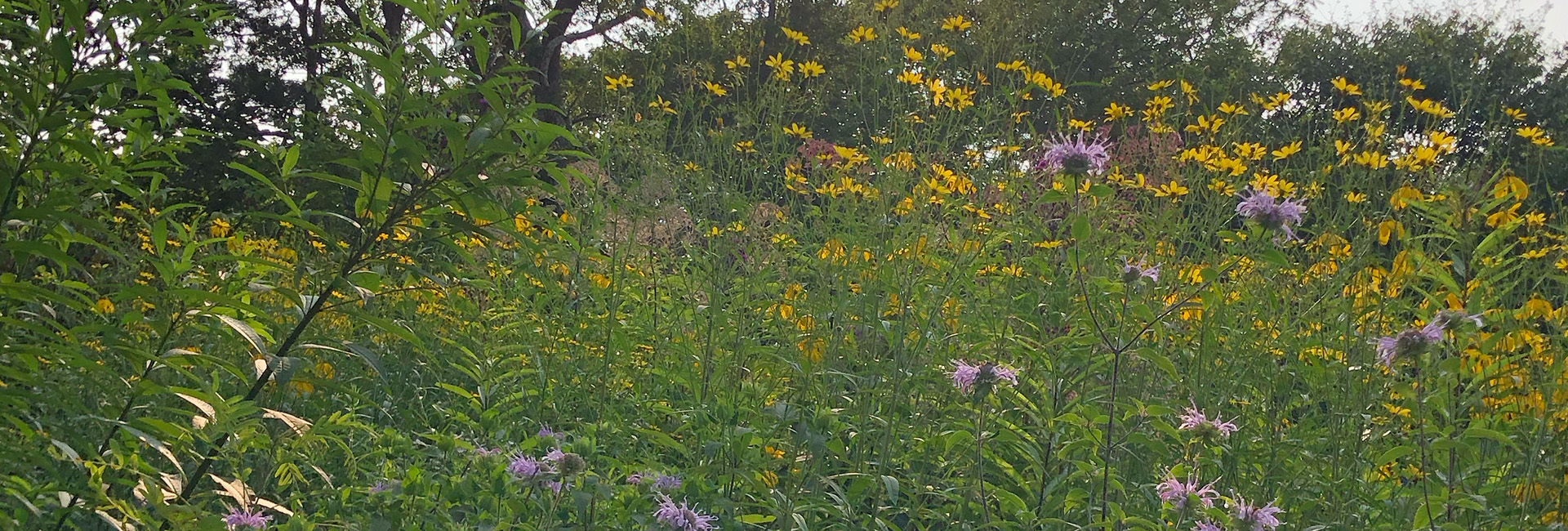
A naturalistic planting of grasses and flowering plants that supports biodiversity and usually requires less mowing than lawn.
- Microbe
A microscopic living organism, such as a bacterium, fungus, or protist. - Microclimate
The climate of a small, specific area that differs a bit from the surrounding area—for example, a shady, cooler corner of a yard or a warm spot near a wall. - Monocot
One of the two main groups of flowering plants, typically with one seed leaf and parallel leaf veins. The northern blue flag iris (Iris versicolor) is a monocot. - Monoculture
A landscape dominated by a single plant species (like turfgrass), which reduces biodiversity and resilience. - Monoecious
A plant species with separate male and female flowers on the same plant. The eastern white pine (Pinus strobus) is a monoecious native tree. - Mulch
A layer of material spread over soil to retain moisture, regulate temperature, suppress weeds, and protect soil. Organic mulches also feed soil over time. - Mycelium
The thread-like vegetative structure of a fungus, made of tiny strands called hyphae. - Mycorrhizae / Mycorrhizal Network
A partnership between fungi and plant roots that helps plants take up water and nutrients while the fungi receive sugars from the plant.
N
- Native Plant
A plant that evolved naturally in a specific region over a long period of time and supports local wildlife and ecosystems. Learn more here. - Nativar
A cultivated variety of a native plant bred for certain traits. Some nativars still offer ecological value, while others are less useful to wildlife than straight species. - Nature-Based or Ecological Gardening
A way of caring for land that works with natural systems instead of against them—focusing on native plants, healthy soil, biodiversity, and non-toxic practices.
- Natural Resource
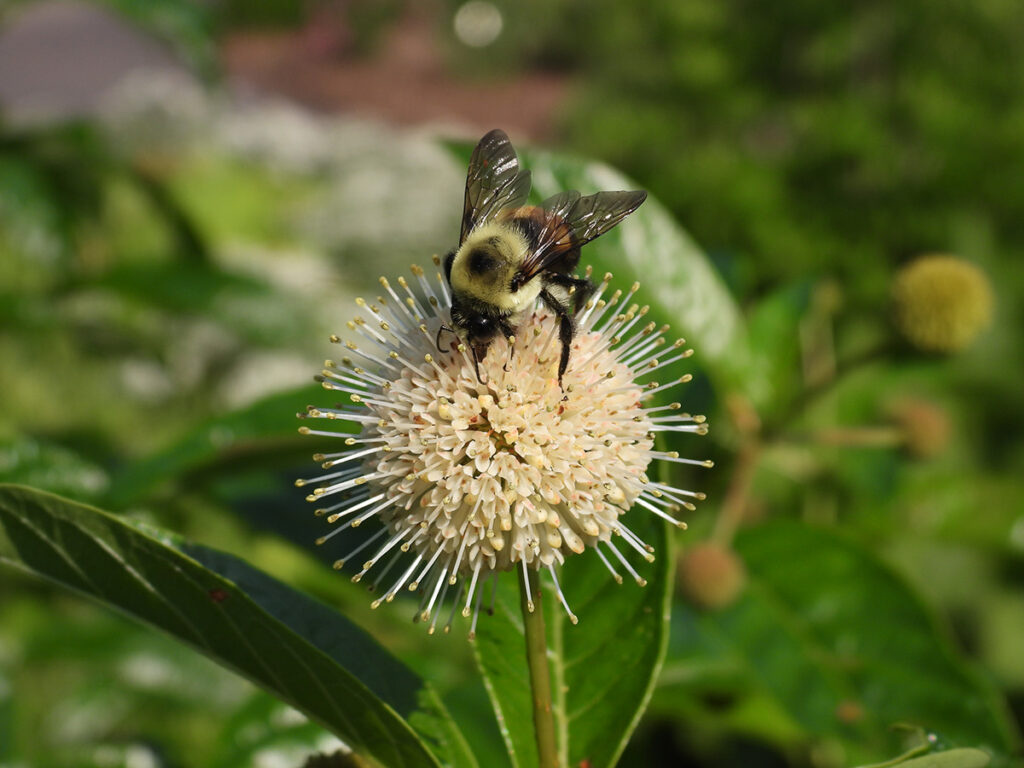
A material or environmental feature people and ecosystems depend on, such as water, soil, air, forests, or minerals. - Nectar
A sugary liquid produced by flowers that provides energy for pollinators and other animals. - Neem Oil
An oil from the neem tree used in some pest-control products. It is often marketed as natural, but it can still affect non-target organisms and should be used thoughtfully. - Neonicotinoids / Neonics
A class of systemic insecticides absorbed by plants, making pollen, nectar, leaves, and other plant tissues toxic to insects. - Nesting Habitat
The features or conditions animals need in order to build nests, lay eggs, and raise their young. - Neurotoxicity
Damage to the nervous system caused by exposure to a toxic substance. - Nitrogen Fixation
The process by which certain plants and microbes convert nitrogen from the air into a form plants can use. - No-Till
An approach to gardening or farming that avoids digging and soil disturbance in order to protect soil structure and soil life. - Non-Target Organism
Any living thing that is unintentionally harmed by a treatment meant for something else, such as a pesticide sprayed for one pest but affecting pollinators too. - NPK
A fertilizer label showing the percentage of nitrogen (N), phosphorus (P), and potassium (K) in a product. - Nurse Plant
A plant that helps other plants get established by providing shade, shelter, moisture retention, or other supportive conditions. - Nutrient Cycling
The natural movement and reuse of nutrients as plants grow, die, decompose, and feed soil life.
O
- OMRI
Short for the Organic Materials Review Institute. OMRI-listed products are approved for use in certified organic production, though “OMRI listed” does not automatically mean harmless in every landscape context. - Organic Matter
Dead and decaying plant and animal material that feeds soil life and helps build healthy soil. - Overwintering
The way a plant, insect, or animal survives through the winter months.
P
- Perennial
A plant that lives for more than two years and usually returns year after year. - Permethrin
A synthetic insecticide in the pyrethroid family, commonly used in tick sprays and toxic to many aquatic organisms and insects. - Pesticide
Any substance used to kill, repel, or control pests such as insects, weeds, fungi, rodents, or nematodes. - Phenology
The timing of natural seasonal events—like leaf-out, flowering, fruiting, migration, or insect emergence. - Photosynthesis
The process by which plants use sunlight, water, and carbon dioxide to make energy-rich sugars. - Phytotoxicity
Damage to plants caused by a chemical or other substance. - Plant Community
A group of plants growing together in the same place under similar conditions and interacting as part of an ecosystem. - Plant Kingdom
A broad scientific grouping that includes all plants. - Planting Natives
Prioritizing plants that evolved in your region because they are usually the best match for local wildlife and ecological function. - Pollen
A fine powder produced by flowers that contains the male reproductive cells of a plant and serves as an important protein source for many bees.
- Pollinator
An animal that moves pollen from flower to flower, helping plants reproduce. Bees, butterflies, birds, bats, beetles, and some flies can all be pollinators. - Pollinator Garden
A garden designed to support pollinators with diverse, season-long blooms and habitat features. - Pollinator Plant
A plant that provides nectar and/or pollen for pollinators. - Pollution
The introduction of harmful substances or energy into the environment, damaging ecosystems and often human health too. - Prairie
A grassland ecosystem made up mostly of grasses, wildflowers, and other herbaceous plants, with few or no trees. - Pre-Emergent Herbicides
Chemicals that prevent seeds from germinating but do not usually harm established plants.
R
- Radicle
The first root that emerges from a seed during germination. - Rain Garden
A planted area designed to capture and absorb rainwater runoff. - Rainwater Harvesting
Collecting and storing rainwater for later use in irrigation, reducing runoff and conserving water. - Reduce the Lawn
Replacing low-value turf with more diverse plantings that support pollinators, wildlife, soil health, and water absorption. - Resilient Ecosystem
An ecosystem capable of recovering from disturbances (like climate stress) due to biodiversity and healthy functioning. - Rewilding / Wilding
Letting natural processes play a larger role in shaping a landscape, often with less mowing, pruning, and chemical input. - Rhizome
A horizontal underground stem that can send out roots and shoots. - Riparian Buffer
A strip of vegetation planted or protected along a stream, river, pond, or wetland to reduce runoff, stabilize banks, and support habitat. - Root Ball
The mass of roots and attached soil of a plant when it is dug up or sold for planting.
S
- Sedges
Grass-like plants in the genus Carex and related groups that are often important for habitat, erosion control, and moisture management. - Seed Saving
Collecting and storing seeds from plants for future planting, often helping preserve genetics and local adaptation.
- Site Conditions
The environmental factors in a particular place—such as sun, soil, moisture, slope, and exposure—that affect what plants will thrive there. - Slow-Release Fertilizers
Fertilizers that release nutrients gradually over time, reducing leaching and runoff compared with quick-release products. - Snag
A standing dead tree or large dead trunk left in place to provide habitat for birds, insects, fungi, and other wildlife. - Soft Landings
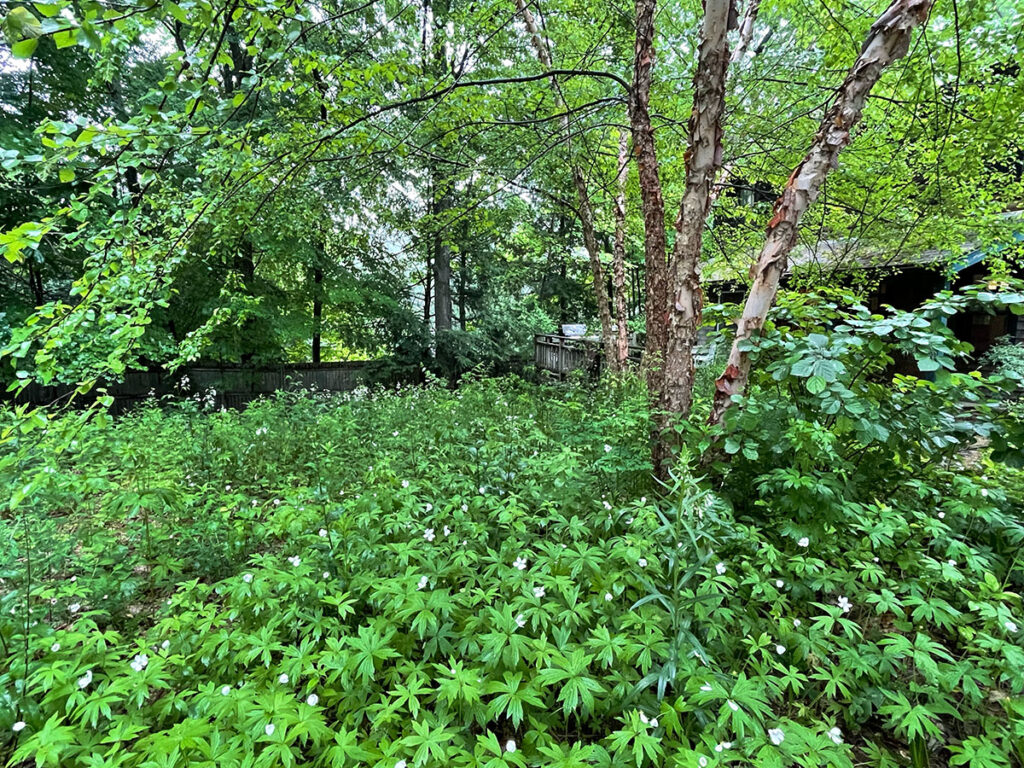
Dense native plantings under native trees that help caterpillars and other insects safely complete their life cycles after dropping from the canopy. Learn more here. - Soil Biome / Soil Microbiome
The community of microorganisms and other small life forms living in the soil. - Soil Food Web
The interconnected system of bacteria, fungi, insects, worms, and other organisms that break down organic matter and cycle nutrients through soil. - Specialist Bee
A bee that collects pollen from a narrow group of plants, or sometimes from just one plant family or genus, such as the spring beauty miner bee (Andrena erigeniae), which relies exclusively on pollen from spring beauty (Claytonia virginica) to feed its larvae - Specialist Pollinator
A pollinator that depends on a narrow range of plants for nectar, pollen, or both, such as the primrose moth (Schinia florida), which relies exclusively on evening primrose (Oenothera spp.) for both larval development and adult nectar. - Species
The basic scientific unit used to classify living things; a group of organisms that are closely related. - Stem-Nesting Bees
Bees that nest in the hollow or pithy stems of plants rather than in soil or hives, such as masked bees (Hylaeus spp.). - Stewardship
Taking care of land responsibly in a way that supports life now and in the future. - Stolon
An above-ground horizontal stem, often called a runner, that forms new plants at nodes. - Stomata
Tiny openings on leaves that allow plants to exchange gases and regulate water loss. - Stormwater Runoff
Rainwater or snowmelt that flows over land surfaces instead of soaking into the ground, often carrying pollutants with it. - Straight Species
A naturally occurring plant species that has not been bred or altered for traits like color, size, or shape. - Succession
The natural process by which plant and animal communities change over time, especially after disturbance. - Systemic Insecticide
A class of insecticides, which includes neonicotinoids, that poisons the entire plant so that its tissues—such as leaves, nectar, pollen, or sap—become toxic to insects.
T
- Tamp
To press down and firm up a material like soil.
- Thatch
A tightly packed layer of dead grass stems, roots, and other material that builds up at the base of turf. - Thicket
A dense grouping of shrubs, ideally native ones, that provides shelter, nesting sites, and food for birds, insects, and other wildlife. - Topdressing
Applying a thin layer of compost or another soil amendment on top of the soil surface or lawn. - Toxic Chemicals
Synthetic pesticides and fertilizers that harm soil life, pollinators, wildlife, and human health. - Toxic-Free Landscaping
Land care that avoids synthetic pesticides and fertilizers in order to protect people, wildlife, water, and soil life. - Tuber
A thickened underground plant structure that stores energy, such as a potato or a dahlia. - Turfgrass
Conventional lawn grass species maintained for aesthetics, often requiring high inputs and offering low ecological value.
U
- Understory
The layer of vegetation growing beneath taller trees, often made up of shrubs, young trees, grasses, and herbaceous plants.
V
- Vernal Pool
A temporary seasonal wetland, usually filled in spring, that provides important breeding habitat for amphibians and other wildlife.
- Volunteer Plant
A plant that comes up on its own from seed or roots, rather than being intentionally planted.
W
- Water Feature
A shallow water source (like a birdbath with stones) that supports pollinators and other wildlife. - Water Table
The level below ground where soil or rock is fully saturated with water. - Watershed
An area of land where all water drains to the same stream, river, lake, or other body of water. - Wildlife Corridor
A strip or patch of habitat that helps animals move safely between larger habitat areas. - Woody Plant
A plant, such as a tree, shrub, or vine, that produces hard, persistent stems.