
Sustainable Color that Mixes Native Plants with Exotic Favorites with Jessica Wiliams
“Rewilding (with Dahlias)” was the irresistible title that Jessica Williams chose for the Digging Deeper garden tour and talk she gave for The Garden Conservancy. On this week’s Growing Greener Jessica shares how she does not fertilize, mulch, or irrigate her lush, colorful, and wildlife-rich garden, and how she enlisted the bees in her program to breed the black-leaved dahlias whose blossoms make her Odd Duck Farm a living jewel box.
September 30, 2026
Subscribe to Growing Greener on Apple Podcasts | Spotify | Amazon
Transcript
Growing Greener Host Tom Christopher
Welcome to Growing Greener, your guide to environmentally informed gardening. Produced in partnership with the Perfect Earth Project, this program brings you each week some expert who puts you in touch with a different aspect of gardening in partnership with nature. Our goal is to make your personal landscape healthier, more beautiful, more sustainable, and more fun.
This is your host, Tom Christopher, and today I will be talking to Jessica Williams, a wonderful gardener in the Hudson River Valley of New York, who has turned her tiny Odd Duck Farm into a paragon of sustainability, support for wildlife, and flamboyant color. I met Jessica at a recent Digging Deeper program she gave for the Garden Conservancy, which she had given the memorable title of “Rewilding (with Dahlias).” She took participants for a garden tour and shared her philosophy of gardening.
Her definition of native plants was perhaps too inclusive for an ecologist, as she includes some common naturalized plants such as chicory and comfrey, which actually originated abroad, but which during their centuries in North America have become a staple of our pollinators. That didn’t stop me, though, from falling in love with her joyous and creature-friendly landscape.
Before we go to the conversation, however, I want to thank Growing Greener’s sponsor, the Garden Conservancy, a national nonprofit dedicated to preserving, sharing, and celebrating America’s gardens and diverse gardening traditions. Through preservation, education, and public access, the Conservancy helps protect these living works of art for future generations. Learn more and discover gardens near you at GardenConservancy.org.
Welcome to Growing Greener, Jessica.
Jessica Williams
Thank you, Tom.
Tom Christopher
Jessica, I met you at a Digging Deeper program you recently gave for the Garden Conservancy at your garden in Highland, New York, in the Hudson River Valley. Can you share with listeners what a Digging Deeper program is and what you shared in your program?
Jessica Williams
first one that I did with them was the Open Days, and that’s sort of a very casual thing where your gardens just open to the public and people stroll through.
The Digging Deeper is a little bit more elaborate. Generally, you pick a subject that is near and dear to your heart. In this case for me, it was the combination of both sort of rewilding my space, but also maintaining the aesthetic that I really enjoyed, which is really vivid, colorful flowers and foliage.
And I didn’t want to give up the beauty of my garden, but I really did want to incorporate more environmentally friendly aspects. And so, it’s something I’ve been struggling with for a while, and I feel like I’ve finally found a way to keep my artistic side happy, but also keep the side that appreciates the environment happy. And I was quite pleased with the results, so I thought other people might be struggling with the same issue.
And so that’s why I wanted to have people to my garden, so that they could see what I had done in the hopes that maybe they would find their own path and continue to explore the options and get more native plants, but also keep the things they really loved. So, that’s what I was hoping people would get from it.
Tom Christopher
You had a title for your program that I personally found irresistible, Rewilding, and then in parenthesis, (with dahlias).
Jessica Williams
I thought it was a pretty funny combination. So yeah, because dahlias obviously are such primadonnas, and not at all the sort of thing you would expect to see in a native plant yard. But that’s my style of gardening. So fortunately, it appealed to other people as well. I was really excited about it.
Tom Christopher
It’s a cliche, I guess, to describe a garden as a jewel box. But I can’t find any other description that fits your creation. It was just packed, erupting almost, with gem-like colors. Could you share with us how big your garden is, and how long you’ve been cultivating it?
Jessica Williams
Sure. We’ve lived on the property for about 23 years now. And it’s a quarter acre in its entirety. And so my garden is less than an eighth of an acre. So, it is a very, very small space. And I was initially kind of horrified by that, because I love gardening. And when we moved here, I had these dreams of having a really big, wonderful garden. But I’ve actually come to embrace it, because it forces me to really think carefully about what I’m doing. And as I get older, I don’t want a huge space that I have to take care of, because my gardening style is really intensive. And so, I think it’s actually worked out for the best.
And I find that whatever it is that I would like to do, there’s always room for it. I think that’s one thing that I hope people take away from my garden as well, is that you can do anything in a small space that you have your mind set on. Because I have a pond. I have perennials. I have annuals. I have native plants. I have evergreens. I have shrubs. I have trees. I have a patio. So, I mean, you can just fill that space up to the brim. And I think the more things you put in it, the more beautiful and exciting it gets, both for the gardener and for the biodiversity aspect of it. So, it’s satisfying on both sides. And that’s always really exciting for me.
Tom Christopher
Yeah, I would say that your style of gardening is intensive, but also joyous.
Jessica Williams
I’m definitely a fan of more is more.
Tom Christopher
If I understand correctly, from the beginning of your work on that landscape, you’ve insisted on sustainability. You told me you’ve never applied fertilizers, although your pet ducks do add their manure, and that you haven’t tried to transform the soil by importing organic material, or applying lime or something like that. Instead, you’ve let the plants create their own habitat by leaving their leaves where they fall to decompose on their own.
Jessica Williams
Exactly. When I started organic gardening, I worked for a wonderful woman named Ann Solomon in New Paltz. And this was when I was in high school, and she was the first organic gardener I had ever met. And when she explained to me why she gardened organically, it just made such beautiful sense that I was like, I don’t know why everybody doesn’t do this. This is amazing. And when I was younger, I did have a different garden at my parents’ house. And I did use organic fertilizers. But it did start to occur to me as I looked to nature for more cues as to what I wanted to do in my own space, that if you look in a forest, I mean, you can see maple trees that tower over us, and nobody is out there fertilizing them, and weeding them and watering them. So, nature clearly has a really good plan. And it’s working beautifully. So, I thought, maybe I’m working too hard at this. Maybe I actually need to take a step back and just kind of observe and see how things worked.
So, one of the first things I did was to leave the leaves. And I think that is hugely important, both because you don’t want to dump them in a landfill, which would be a terrible thing to do. But also because the plants actually do create their very own fertilizer, and they put it right at the base of where they’re growing. It’s just so incredibly ingenious. And the fact that we haven’t realized that is mind boggling. So that is one of my favorite things to share with people, is to keep the leaves in place, both because it is really good for the insects for the overwintering, but also fantastic for the plants. And they will gradually build up the soil themselves in the ways that they like.
The other thing that I do is I don’t try and grow plants that are unhappy in my yard. Which is not to say, I do give it a try, usually two or three times. And if I’ve killed something three times, I do tend to give up. So, you know, you sort of tailor the plants to your space after a while. And I think that’s really exciting, because when you have a garden that is really unique, and the plants in it are different from the gardens, maybe even right next door to you, because interestingly, soil varies from like yard to yard, even in a neighborhood. And the amount of light that you have, the moisture, the type of soil in our backyard, we just have fill. So, it’s really terrible soil, it’s incredibly well-drained, so it’s very dry. And I have a completely different group of plants in the backyard than I do in my front yard.
So, just even observing those little differences will help you find the plants that are happier in their places. And when you have a plant that’s happy where it’s growing, you don’t really have to do anything to it. It’s very self-sufficient. So, I’ve gradually adjusted my perspective from wanting to grow things that I just really want to growing things that actually want to be here as well. That was a little bit of a struggle. I am a control freak. So, accepting that was hard. But now that I have, I’m really running with it. And it’s really so much fun. And I highly recommend that people give it a try, because it’s really satisfying and the amount of labor that you have to put in is so much less. So, your enjoyment is so much more.
Tom Christopher
When you put it that way, it makes a huge amount of sense. Because so often in gardening, we get sidetracked into trying to make things grow where they aren’t well adapted. And as you say, you know, then they’re always going to be limping along and prone to problems and just not flourishing. And why do that?
Jessica Williams
Exactly, right? It’s funny, some of these things are so obvious, but sometimes it takes getting older to accept the wisdom. So, it’s been a process.
Tom Christopher
So, you don’t favor irrigation either, do you?
Jessica Williams
No, no, I do not irrigate anything, partly because we have town water, so we pay for it, which is a big incentive to find alternatives. So, partly leaving the leaves also helps keep the moisture in the soil, and adapting to plants that can deal with the dry and wet conditions depending on where they need to be.
The other thing that I do is, of course, when I do plant something new, I do water it in consistently. But I also do grow a lot of things from seed. And often I will just scatter the seeds in place. And I find that is a really good system, because a lot of things don’t grow. But the ones that do really thrive. So, they sort of self select for who’s going to be happy there. So, I tried lots and lots of things, and I fail with lots and lots of things. But the ones that do stick around and grow, they’re super enthusiastic, and they’re really happy to be here, and I don’t have to fuss with them. So, that’s a huge bonus for me, and I think better from an environmental standpoint as well.
Tom Christopher
Plants that you start from seed in place, the roots go right down, whereas I do a lot of starting vegetable seedlings indoors in the late winter, early spring. And when you put those out, they’re these little bundles of roots in an artificial growing medium. And it’s a shock to them to move into their final site, even if it’s a good soil. And, of course, you have to baby them along until they recover and root in. But with things that you started from seed right there, they’re rooted in from the moment they sprout.
Jessica Williams
Right, right. That was not something I initially planned on doing. It was just sort of trial and error. And I think all of us have had volunteer seedlings that have just popped up here and there. It’s usually someplace terribly inconvenient. But they’re almost so much bigger and stronger and happier than the ones that we’ve planted deliberately. So, I kind of thought, okay, well, I’m observing this. And they made themselves happy where they’re growing. So, maybe I should just scatter the seed around and see what happens.
Tom Christopher
Another aspect of your garden that I appreciate is that it isn’t dogmatic. That is, you’ve added quite a number of native plants to support butterflies, bees, and other wildlife. But you’ve also made room for all of your favorite non-natives and, of course, notably dahlias.
Jessica Williams
Dahlias were something that I’ve always enjoyed because I do really love color. And there’s nothing more vibrant and exciting, in my opinion, anyway. But one of the things that I did do with the dahlias is I noticed that when I was growing the big fluffy double dahlias, the pollen is not available in the center for the insects. So, I did alter my growing to include a lot of seedling dahlias, which are almost always singles. And I find that the pollen is really enjoyed by particularly my bumblebees. But also, ironically, hummingbirds, butterflies, all kinds of native bees, even the wasps. So, I feel like they’re actually contributing a lot to the garden, as well as their aesthetic values. So, I feel really good about growing them.
And their stems are also hollow. So, when I cut them down for the fall, I will stack them or leave the stems on the ground because they’re a really good spot for a lot of our native bees to overwinter. They’re just contributing to the wildlife as well as making me happy. But I feel like any plant that draws you into the garden, like every single day I get up and I go running out because I want to see has a new flower opened on a dahlia that I just got, and I think whatever draws people into their space with that kind of joy and happiness to see what’s going on, like if you need that plant in your garden to get you out there and do that, then it is worth growing that plant.
But I think it’s really important to remember that a garden is for you as well as for all of the creatures in your yard. And so you need to be back there and enjoying it too. So, you know, if you want to grow roses, obviously try not to do roses that need lots of pesticides to make them happy. But there’s always like a workaround and having those beautiful plants is so important. And to me, that was the other aspect that I really wanted people to know is your yard is for you as well. Like you need to be able to be out there enjoying it. And that way you’ll nurture it ,and it will get more and more beautiful. And it’ll be more exciting for you. And then you’ll do all kinds of things that are really good for all kinds of other creatures as well.
Tom Christopher
I’m a big proponent of native plants. I discovered them relatively late in my career, probably the last 20 years. I’m so pleased that there’s a really vigorous movement to honor and include native plants. But I’m really sorry that it’s gotten sidetracked sometimes into arguments about, oh gosh, almost purity, you know, whether or not you’re all native plants or what percentage of native plants versus introduced plants. The percentage has a certain validity to it because I guess you get maximum support of wildlife with a certain percentage of native plants versus introduced plants. But I think the message that there’s room for all different kinds of beauty and nature in a garden is really important because you don’t want to turn people off and turn this into some kind of chore.
Jessica Williams
Yeah. I always think of the native plants kind of like salad. They’re really good and we all know that we need to plant them. But maybe, I just speak for myself, salad is not one of my favorite things. So, I feel like putting the dahlias is kind of like putting the sun-dried tomatoes or the bacon bits or the ranch dressing on the salad. And it just makes it that much more delicious. So, it’s a really good thing. And you can still have all of the good healthy things, but if you can make them more palatable, depending on what your aesthetic is, I think that’s really a worthwhile way to approach it. And I don’t want to turn anybody off from gardening because it’s such a fantastic activity. And I think once you’re involved in it, you will naturally become more excited about all the other aspects. I would like to be as inclusive as possible.
Tom Christopher
So, tell me, if you will, about the breeding program that you’ve been pursuing with dahlias because I think that’s really fun and I know very few gardeners, myself included, who are actively pursuing the breeding of certain types of plants.
Jessica Williams
Well, you know, the funny thing is that plant breeding is ridiculously easy. And I think that’s something that all of us have forgotten about. The seed companies are very excited that we’ve gotten about it because we don’t bother to do it ourselves anymore. But average home gardeners used to breed their own plant varieties regularly until quite recently. There’s nothing complicated about it at all. And to breed dahlias, most of my flowers are single flowers. So, the bumblebees actually do most of my pollination for me. And bumblebees tend to fly in a straight line. So, if I have several dahlias that I would like to crossbreed, I will plant them in a row because then the bumblebees will transfer the pollen from one to the other. I don’t really have to get involved. So, it’s a fairly casual thing. But the thing that I breed for is black foliage because to me, any plant that is in my very tiny backyard really has to earn its keep. And as you know, dahlias are large plants. And for the most part, they tend to be green. Often, they don’t flower until the end of August. And I really don’t want to look at a big green boring plant all summer long waiting for flowers. So, my solution was that when I discovered these dark leaf dahlias, I was really excited about them because they stood out. They gave me a lot of contrast and they were really beautiful, but they were hard to find. It seems like in England, there are a lot more varieties available, but in this country, there were only a few. And so I thought, well, I mean, it can’t be all that hard. I’ll just try it.
So, I planted a bunch of my seeds and the genes for the black leaves are sort of recessive. So, you don’t get a lot of them. But I culled all of the green ones and I planted only the black leaf ones. And in two or three years, I’ve gotten several that are really, really beautiful. And this summer, two of the absolute blackest leaf ones I’ve ever had before. So, I feel like my breeding career has come to its apex and I’m thrilled. It’s just so much fun. And I highly recommend everybody give it a try. You can try it with your tomatoes. You can try it with your lettuce. You can try it with your sunflowers. Plant breeding is actually ridiculously simple and really enjoyable. So definitely an aspect that most of us don’t explore and is well worth checking out.
Tom Christopher
And of course, with dahlias, if you get one that you particularly like, you could save the tubers over the winter. And so then you get the same plant back the next year or multiples of it.
Jessica Williams
Exactly. And the great thing, of course, as you know about plants is you get multiples all the time so you can share them. And that is, to me, a really enjoyable aspect. Definitely.
Tom Christopher
Jessica, I need to interrupt for a moment to remind listeners that this radio station is WESU 88.1 FM and this program is Growing Greener, a weekly conversation about gardening in partnership with nature. This is your host, Tom Christopher, and today I am speaking with Jessica Williams, the creator of Odd Duck Farm in Highland, New York, about her joyous and nature-friendly garden.
So, Jessica, when did you develop an interest in natives?
Jessica Williams
That’s a good question. I’ve been gardening since I was about five, so it’s been a long time. I really was drawn to exotic plants, to be honest. When I was younger, I loved bananas and anything variegated or big, giant leaves. Castor beans are a big favorite of mine. That, of course, is how I was drawn to the dahlias and the canna lilies. And that was the direction I went in for a long time. And I really, really loved it. So, native plants were not a priority at the time, but I did always notice that there were plants that wanted to grow in my garden that I had not planned on, but were, I guess, native plants. And so things like asters and chicory and, you know, even dandelions I enjoy because partly I eat them. But also I noticed, you know, a lot of things enjoy their flowers, so I would leave them. And I guess it sort of started that way in a very passive fashion of just sort of allowing the local plants to join me.
And then as I noticed, more and more of the insects were really drawn to those plants and not necessarily what I had planted. I really enjoyed having them, and I wanted more of them. So, whenever I get interested in something, I’m a big nerd. So, I do this complete deep dive into it. And that’s when I got really interested in native plants. So that was probably about 20 years ago.
There really weren’t a lot of them available. And the knowledge base for what was native was very broad. So, like, you were told, you know, grow echinacea and grow smokebush and grow viburnums. That was pretty much what I was told. So I went out and I bought all those things. But of course, I didn’t buy the native varieties, because they weren’t even available in commerce at that time. So, I ended up with a lot of things like kusa dogwoods, not native at all. But I didn’t know that at the time. So, I really had to refine my understanding of what native plants were back when there really weren’t any books.
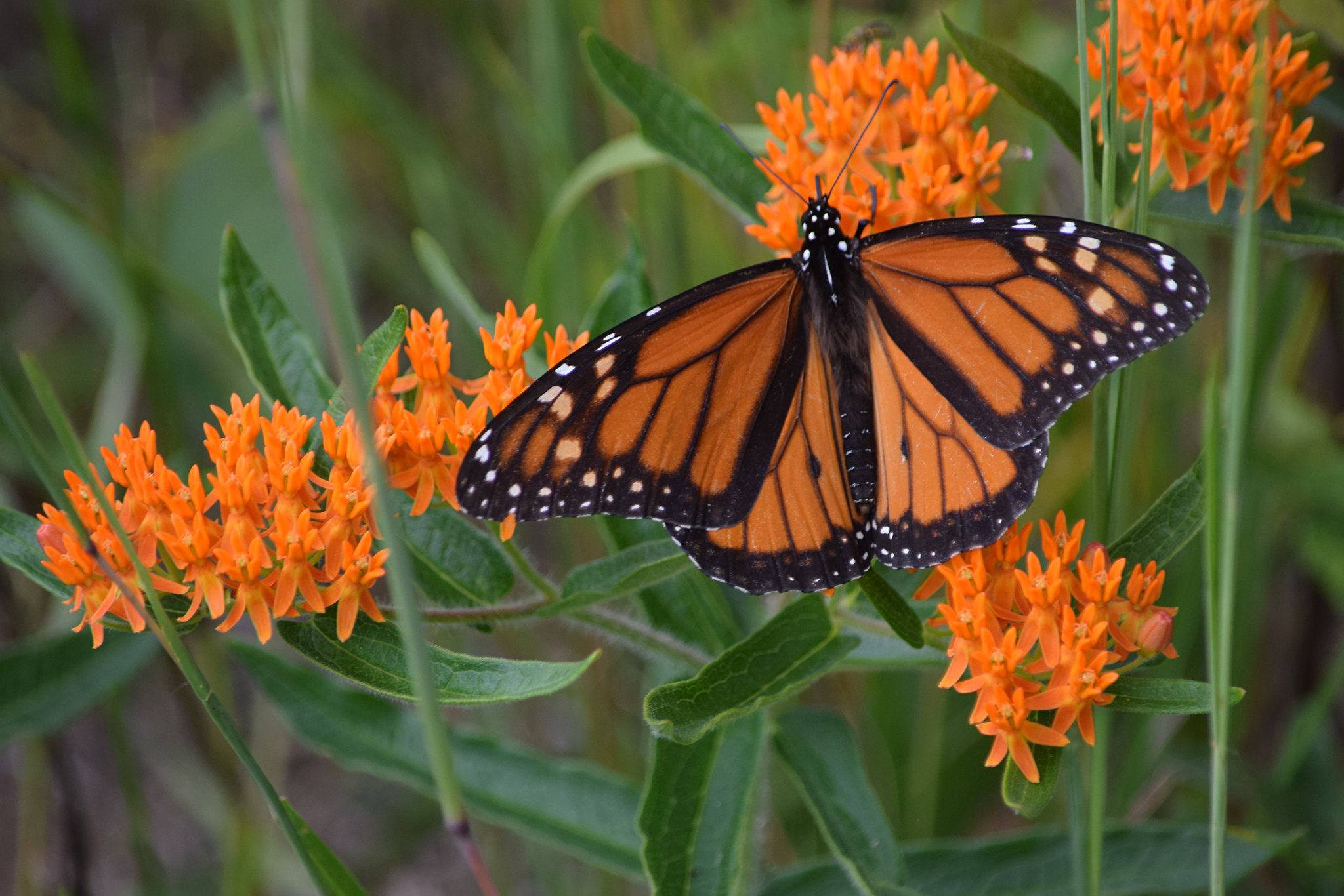
It’s been a really interesting way to approach gardening. And I like having the native plants because I really enjoy the insect activity and they do have a more subtle beauty. And I think it’s a really nice balance for a lot of the other bigger, louder plants that I enjoy. As I planted more of them, of course, they’ve spread because they’re very happy here. So, when I noticed one of them just popping up somewhere, I tend to just work around it. So, I have milkweeds growing in the middle of my dahlia bed, and they’re perfectly happy. And I don’t bother them. And the butterflies come and they enjoy the dahlias and they enjoy the milkweed. Everybody gets to play together. It’s a nice approach.
Tom Christopher
You also have an interest in healing plants, don’t you?
Jessica Williams
I do. A lot of our native plants do have a lot of healing qualities, which is really exciting. Goldenrod, for one, I’m just starting to learn about. So that’s really interesting. The other things that I grow are nettles, or I should say the nettles grow themselves. I appreciate them and leave them. The jewelweed, of course, is really good when people get poison ivy. You can put the jewelweed on the area that you got the poison ivy and it helps. I also grow comfrey, all different types of mints, anise hyssop. I grow lemongrass, lemon balms. So those are all really wonderful plants for making teas and tinctures. Anne Salomon, the woman that I had worked for at Tweefontein, was an herbalist. So, I guess I just picked up a lot of things from her without even realizing it. The other thing that I really like about the herbs is a lot of the plants that I grow don’t have a fragrance, particularly dahlias, for instance. And to me, being in the garden should engage all of the senses. A lot of the plants that I grow provide beauty, but they do not provide fragrance. So, the herbs are often very fragrant.
So, I love that when you walk through my garden, you get all these incredible scents, probably from accidentally stepping on them because I never make the proper paths. It adds this whole extra element of enjoyment. So ,they’re great whether I make something out of them or I just enjoy them.
Tom Christopher
And you also harvest materials from your garden to use in wreath-making. You teach classes about that craft and you also make wreaths for sale, I think.
Jessica Williams
I don’t actually sell my wreaths but I do workshops and that’s actually kind of funny. I never planned to become the wreath-making workshop person. It started because I was in a craft store several years ago and I had been teaching classes at the local libraries on environmentally-friendly, pollinator-friendly gardening and I really enjoyed it. And I was in line behind this lovely woman who had her cart full of plastic garland and plastic Christmas trees and plastic wreaths and plastic poinsettias and she was very nice. And I was chatting with her while we were in line and I was looking at the cart. It occurred to me that it was really painful to see all of this plastic imitation version of things that I thought were so beautiful that should smell heavenly. I mean pine needles are one of the most incredible fragrances in the world and here they were in this sad, terrible version.
And it, I don’t know, it just really upset me. So, when I got home I thought, you know, I have this platform. I’ve been teaching people about gardening. Maybe the libraries would be interested in a wreath class. So, I proposed it. They said sure. So, I went around my backyard and I just cut a whole bunch of random things and I made the wreaths out of grapevine. I brought everything in.
People were a little startled at first. They wanted their glue guns and they wanted their plastic flowers. And so, I had to actually explain myself that, you know, natural things are meaningful to us and we want to bring them into our homes because they’re real and they remind us of the beautiful world around us. And somehow, it’s gotten terribly perverted into this plastic version, but the desire to have nature near us is very real. And they’ve done all kinds of studies recently that proved that having live plants in your home, in your office, actually increase your well-being, your mental health, and all kinds of other good things. So, we want these things. We just kind of forgot that they should be alive.
So, one of the things that I like to do is talk a little bit about that when I do my wreath classes. And people always comment on the incredible fragrance because all the materials smell really good. And everybody’s in a good mood by the time they leave because I think we really crave that connection with nature. And I explain to people that when they’re done with their wreath, if they get tired of it, they can either put the whole thing right in their compost or they can take off the materials and reuse the wreath again and again. So the possibilities are endless and they get really excited.
And I had one woman, I remember, she had come to a couple of my wreath classes and she was really fascinated with the sumac berries because, you know, they’re red and velvety and so beautiful. And she thought they were something really exotic. And when I explained to her, that’s a native tree that grows right in her backyard, most likely, she was really confused. And I guess she went home and realized she actually did have one in her backyard. So, the next time I saw her, she told me that she had prevented her husband from cutting it down because she was looking forward to using the berries in her wreath. And I was really excited because that’s exactly why I’m doing this. And it made me so, so happy.
Yeah, I feel like kind of everything is connected. And the wreath classes give me a way to reach a population that maybe wouldn’t consciously say, oh, I’d love to grow native plants that are important to me. But I kind of sneak up on them with the beauty of the wreaths and before they know it, they’re excited about it.
Tom Christopher
And it sounds like a fun experience all around too, as well as a valuable teaching tool. So, Jessica, I just want to say in closing this conversation that I value gardening as a way to heal nature and to contribute and involve myself in nature, but also as a way to give joy to people. And as I said, I think yours is superb in both respects.
Jessica Williams
Thank you so much, Tom. That means so much to me. I really, I’m thrilled that you felt that way.
Tom Christopher
Do you still open your garden to the public through the Garden Conservancy Open Days program?
Jessica Williams
I don’t do the Open Days anymore, but I will be doing a Digging Deeper next year, probably in September on a similar subject matter, because it seemed to go over very well. And I think there’s a lot of interest and it’s something I feel really passionately about. So definitely. And people can follow me on my Instagram account if they’re interested, which is @oddduckfarmhighland. And I do mention a lot of the things that I’m working on on that. So, if they’re interested, they can look at that. But if people are interested in doing a wreath workshop or just have questions about my garden, they’re more than welcome to contact me through that.
Tom Christopher
Okay, that’s great. Yeah, because I think a lot of listeners would enjoy one of your classes or one of your talks. Well, thank you very much for joining me today and sharing your excitement in gardens and the natural world.
Jessica Williams
Thank you, Tom. It’s been a pleasure.
Tom Christopher
That’s all for this week’s Growing Greener. Please join us again at the same time next week on this radio station, WESU 88.1 FM, for another episode. Or listen to Growing Greener as a podcast at www.thomaschristophergardens.com. If you have comments or suggestions, please share them with me, Tom Christopher, via the same website, www.thomaschristophergardens.com. Growing Greener is produced as a community service in partnership with the Perfect Earth Project, a nonprofit dedicated to educating, engaging, and inspiring individuals, land care professionals, and decision makers to adopt toxic-free, nature-based, and climate-responsible landscaping practices.
Transcribed by TurboScribe.
About Growing Greener
In 2025, Perfect Earth Project partnered with Thomas Christopher’s Growing Greener podcast. Tune in every week to listen to Tom talk with gardening experts and leaders, who are working and living in harmony with nature. They share their different perspective on how to make your personal landscape healthier, more beautiful, more sustainable—and more fun.
Support for Growing Greener comes from the Garden Conservancy, a national nonprofit dedicated to preserving, sharing and celebrating America’s gardens and diverse gardening traditions. Through preservation, education, and public access, the Conservancy helps protect these living works of art for future generations. Learn more and discover gardens near you at gardenconservancy.org.
Share