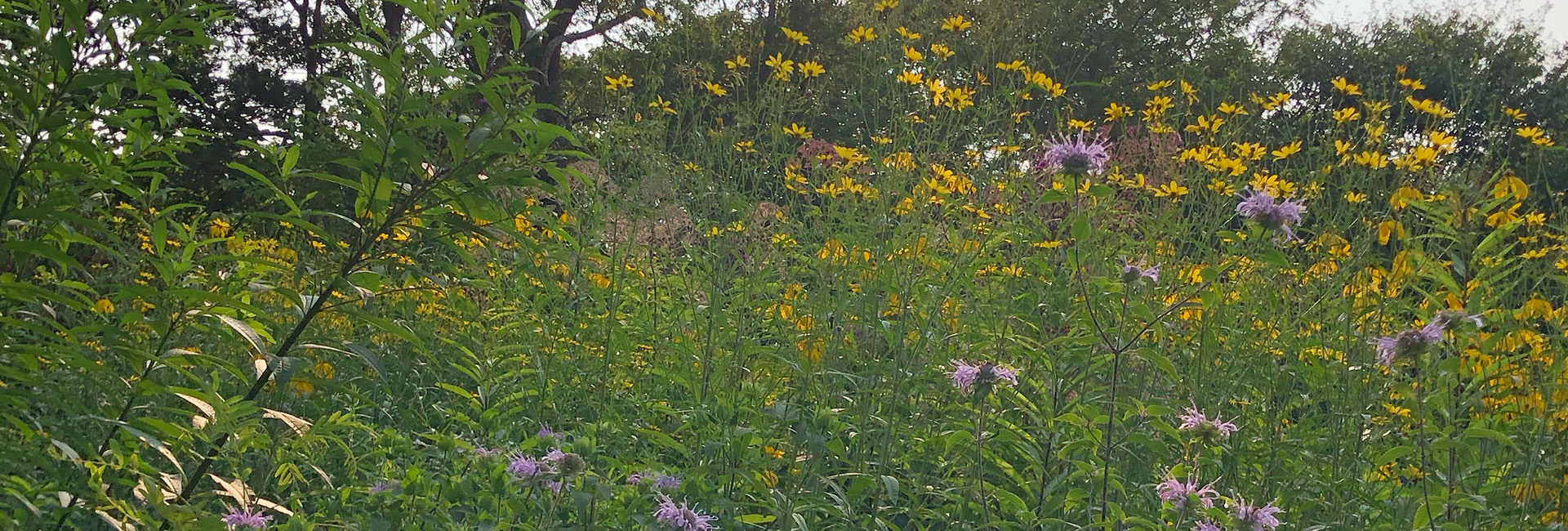

A Franciscan Brother Finds his Ministry in Ecological Restoration
Can our personal spirituality provide a path to a different, more positive relationship with Nature? In this conversation, first broadcast in December of 2024, Brother James Lockman of the Catholic Church’s Franciscan Order describes how the beauty of Nature inspired his spiritual journey and how that led him to a life dedicated to restoring damaged ecosystems.
October 28, 2026
Subscribe to Growing Greener on Apple Podcasts | Spotify | Amazon
Transcript
Growing Greener host Tom Christopher
Welcome to Growing Greener, your guide to environmentally informed gardening. Produced in collaboration with the Perfect Earth Project, this program brings you each week some expert who puts you in touch with a different aspect of gardening in partnership with nature. Our goal is to make your personal landscape healthier, more beautiful, more sustainable, and more fun.
This is your host, Tom Christopher, and this week I will be replaying a conversation I had in December of 2024 with Brother James Lockman of the Catholic Church’s Franciscan Order. Founded in 1209 by St. Francis of Assisi, the Franciscans are known for their devotion to a simple life of poverty and service to the poor and marginalized. St. Francis found much of his spiritual inspiration in contemplation of the natural world, which he described as, “the mirror of God.”
Brother James will share with us now how he has been inspired by this aspect of St. Francis in his own ecologically-based ministry, and how St. Francis has become fundamental to the environmental teachings of the then-current Pope, Pope Francis. Before we proceed, I want to make clear that I am not a member of any organized religion, and that I am not seeking to promote any particular creed. I have come to believe, however, that a fundamental part of addressing our current environmental crisis is developing a new personal relationship with nature. Part of that comes from a scientific understanding, but I am convinced that we need to establish a new emotional fellowship as well, and that spirituality can be a path to that. This has certainly been true for Brother James. If listeners have other, different examples to share, I hope they will contact me.
Before we go to the conversation, though, I want to thank Growing Greener’s sponsor, the Garden Conservancy, a national nonprofit dedicated to preserving, sharing, and celebrating America’s gardens and diverse gardening traditions. Through preservation, education, and public access, the Conservancy helps protect these living works of art for future generations. Learn more and discover gardens near you at GardenConservancy.org. Welcome to Growing Greener, Brother James.
Brother James Lockman
Thank you, Thomas.
Tom Christopher
You are a friar of the Franciscan Order of the Catholic Church. Have I stated that correctly?
Brother James Lockman
Yes.
Tom Christopher
And what are the four principles of the Franciscan Order?
Brother James Lockman
I would say prayer, joy, and solidarity with one another.
Tom Christopher
That all sounds very laudable. Could you tell us briefly about St. Francis of Assisi, the founder of the Order?
Brother James Lockman
Well, we’re two years off of the 800th anniversary of his passing, which was 1226. And I’m sure we’ll get into some of the current work that’s being done. But in 1224, by then was blind and could not write himself, but basically sang what is considered to be the first verse in Italian. The language of Italian was really just emerging at that time, and it became known as the Canticle of Creation.
The Canticle is “All Praise to You, Lord,” which in Italian translates to Laudato Si’, which is the title of the encyclical of Pope Francis that came out about nine years ago on the environment. So Francis, in sending out the brothers to sing this song of praise to the Lord for all the different elements of creation, and that Francis referred to each of these elements as brother and sister, prefaced, and this was actually eyewitness chronicler at the time, quoting Francis when he was sending out the brothers in this initial effort, basically noting actually a little bit of critique, social critique of his own time. And he was quite aware of environmental destruction around him at the time, and he referred to that as being very displeasing to the creator.
So in this song, he was hoping that the friars would be able to call people to ecological conversion, as we would refer to that today as such. The word ecology didn’t exist then. So, Francis is, even before, say, the last 30 or 40 years of rising environmental consciousness in the world today, has been thought of as the patron of the environment or the patron of ecology. And Pope John Paul II actually formally named him as the patron of ecology. So, there are many of the early works, writings that came out either by Francis himself or by his contemporaries, noted how sensitive Francis was to each and every element of creation. And the culmination of that was to realize we’re all created by God. And however, you understand that, and therefore we’re all related. And not just in the human family, but in the family of creation. So, this was really, it was a remarkable breakthrough in Western spirituality, where I suppose you could call it the spiritual anthropology, had certainly God at the top and then humans, and then everything else kind of falling out below. And Francis kind of turned that upside down, and in his own very gentle, humble way, wanted to joyfully call people to the greater consciousness about how we were, even 800 years ago, abusing the earth that God has given to all of us to nurture us and sustain us. So that canticle really, I think is two years before his death, summarized a very significant part of who St. Francis was.
It’s a part that we maybe haven’t paid all that much attention to down through the years, until I guess it was probably around the 1960s. Scholars began to really pull the significance of the canticle out and examine it in light of everything else that we know about St. Francis.
Tom Christopher
Yeah, I mentioned this because I’ve, I trained as a, well actually originally, I got a university degree in classics, but I quickly moved on from there. I loved being outside and I loved being in nature, and I trained as a horticulturist. And I worked for 50 years now as a horticulturist. And I’ve become, over that time, I’ve become more and more interested in gardening as a way to learn how to relate to nature, and also change how we relate to nature. And I see these terrible environmental crises that are challenging us. And so, I’ve studied better techniques for managing yourself with respect to nature and the landscape. I’ve become very interested in native plants and restoring the landscape as best I can. But I’ve become increasingly convinced in recent years, that along with learning these techniques and these goals, there has to come, I think, a fundamental spiritual change in a lot of humanity. Because I think it’s not enough to tell people you can manage nature better in this way. I think they have to really want to relate to nature in a different and more healthy way. And that really fascinates me about St. Francis.
Brother James Lockman
Right. And the way that that’s been understood now in the 21st century, and Pope Francis’s work on Laudato Si’, the uniting theme in that work is called Integral Ecology, which integrates humankind with all of creation. And chapter six of the encyclical is really kind of, okay, now what do we have to do? And the very first words of that chapter are, “We have to change.”
Pope Francis addressed Laudato Si’, not just to Catholics, but to all peoples, laying out not only the urgency of addressing the ecological crisis today, but also how that is, again, part of our own spiritual conversion. Over the last number of years, we’ve talked about developing ecological consciousness. And again, this is an approach that is not a one size fits all. Each person can understand his or her relationship with nature in a whole number of ways. And some of the early writings that I’ve done, I’ve talked about. I’m a botanist and horticulturist by training in a garden since I was two and a half years old. That’s 70 years ago now.
The understanding that there are many pathways into this integration of oneself with one’s environment. And on the one hand, I specifically spoke about the garden, which whether we’re out there with our hands in the soil or, you know, living in a dense urban area, it has to do with the cultivated landscape around us. The trees, the birds, everything that is visible most days to most people.
So, there’s the garden or the cultivated landscape. And then there on the other end of that is the wilderness. I’m not sure, Tom, where you live, but here in California, we’re blessed with having an amazing amount of wilderness that is protected. So, access to hiking or being out in the wildness of nature, it may not be available to as many people as the garden landscape entry into nature, but it certainly can be a remarkably spiritual experience that often does lead to change, conversion.
Tom Christopher
Brother James, I was very impressed to learn that your own ministry, your personal ministry is not only as an educator at San Diego University, but also as the senior vegetation and restoration ecologist for Tierra Data, a company that restores natural habitats around California, such as in areas the state agency Caltrans has disturbed in the course of freeway construction. You received a master’s in environmental horticulture from the University of California, Davis. Isn’t that correct?
Brother James Lockman
Yes.
Tom Christopher
How did you end up making that work part of your ministry?
Brother James Lockman
Well, first of all, in terms of the University of San Diego, I’m not a faculty member there. I belong to the community of friars that teach at our theology school that’s part of the university. I certainly have influence. And they’re on the train. They get the stuff. But I’ll go back just a little bit further than that, and I made reference to it a little bit earlier. And I’ve told this story a number of times. Perhaps you’ve even seen it in some things that have been printed more recently. When I was two and a half years old, we lived in a little bungalow house in West Los Angeles that later got paved over and became known as the San Diego Freeway, or the 405. And I woke up one morning. We were a growing family by then and had clearly outgrown this little, tiny house. But my grandfather had made the back porch into his own bedroom by just glassing it in. And that was my bedroom. He had passed away a few months before I was born. He was a farmer from the Midwest, and I woke up one morning. It was probably in March of 1955. And I looked out the window, and I saw something that I’d never seen before. And it looked like this big, giant, pink bouquet of flowers. So, I kind of padded my way out there in my pajamas and ended up sitting under this tree and was under this dome of just really great beauty. It was early morning. The sun was coming up. It was all, you know, just it was probably a perfect time of day to be out there. Probably 45 minutes later, my mother came running out the back door because she had found my bed empty and was panicking. She didn’t know what happened to me. And I have come to realize that that experience was a mystical experience. It imprinted itself on my focus of interest ever since.
I grew up gardening. I went to university. My bachelor’s degree is in botany, largely focusing on Southern California native plants. And my master’s degree is in environmental horticulture, both from Davis. And then after I joined the Friars, I had those degrees already. I was really encouraged to continue exploring the theological slash spiritual dimension of the ecological training that I’d already had.
So, in my theological studies, which came a few years after my academic work at Davis, I decided to take on a problem of something that had been interesting to me in some ways since I was a kid. The Amazon rainforest. And in light of, at that time, our current theological understanding linked with the sociopolitical environment, that has now, I condensed it, and it’s an essay in a collection of works called Covenant for New Creation. But in that work, I think I was really grappling with kind of an earlier version of what Pope Francis calls integral ecology, because I very much wrote it from not only the perspective of the exploitation of the natural environment, but also its impact on local people.
So, in that work, I was able to make kind of a formal bridge between my early gardening, my higher education, and my spiritual theological interests. And I was attracted to the Franciscans in my 20s because, you know, Francis was very much seen at that time as a nature mystic and found basically ecstasy when probably by himself or with only a single companion in a contemplative experience out in the natural world. We even know where some of those places are now in central Italy, and often folks make pilgrimages to those places, hoping to kind of capture the experiential reality of what made these places so important for St. Francis himself.
So again, certainly the popular imagery of St. Francis throughout my life as a Catholic, I was in Catholic school until all the way through high school, clearly was an invitation for me to consider diving deeper into that spirituality.
Tom Christopher
Brother James, I need to interrupt our conversation to remind listeners that this program is Growing Greener, a weekly conversation about gardening in partnership with nature, coming to you from the studios of WESU 88.1 FM in Middletown, Connecticut. This is your host, Tom Christopher, and today I am speaking with Brother James Lockman of the Franciscan Order about his ministry as an ecological restorationist.
Brother James, I’d like to return to an exploration about how you found your personal ministry as a Franciscan in the area of ecological restoration.
Brother James Lockman
In my time, my novitiate was in the early 1980s. We were really encouraged to think about, okay, what do you see your ministry focusing on in your life? And if it was sacramental, then, you know, you were considered for what we would then call an ordination track. It was something else, you know, whether it just be basic service or, you know, kind of higher headier things. Like when I got into graduate studies beyond our master’s degree, and that’s really how we were directed. So right pretty much from the get-go, I was encouraged to continue to develop not only my own practice as an ecologist, but my education as an ecologist. So, I was able to do that. And now I’ve had this particular position for about 15 years after doing lots of different things in several different countries. And it’s really brought together for me, not only my entire educational experience, but very much of my own life experience.
There aren’t very many friars that are, you know, have much education in science or much more into letters and philosophy and theology. And when I talk about my position as being a restoration ecologist, they have no idea what I’m talking about. So, I came to the realization that I had to describe my work in terms of ministry that perhaps they might better understand.
So, I’ve come up with, and this was over 10 years ago now, but I’ve come up with the phrase that my ministry is healing the earth. So, the work of Habitat Restoration, which is a work frankly that I brought to the company. They wanted to do it, but didn’t have anybody with the kind of background that I had. I got that part of our business going along with my colleague Fausto Larios. And we started off, it was slow, but if you know what the exponential curve looks like, it’s a J curve. By four years into it, after doing, you know, we had jobs or projects that were, you know, pretty decent, but all of a sudden, it took off.
And that’s when we got in with Caltrans and we’re looking at multimillion dollar projects. So, from there, we’ve done over a thousand acres now in San Diego County of Habitat Restoration. And a lot of it has been Caltrans. Our district here in San Diego has a very active environmental stewardship program. And because of my science background, I was able to even help our Caltrans contract managers, who are largely landscape architects by training, put their projects together literally from the soil up with a kind of a much deeper understanding of the ecology that we’re working with. So, you know, we’ve done things like constructing or restoring wetlands, which is a very complicated type of project and a really essential one given the function, the ecosystem benefits of wetlands.
We have this habitat here in San Diego. It also occurs up near Sacramento. They’re called vernal pools, which are usually on heavy clay soils that have kind of an undulating topography that are home to now, because most of them have been developed into housing or ag[riculture] or whatever, they’re vastly diminished from what they were. And there are, I don’t know, I would say probably up to 15 to 20 endangered species that are only found in association with vernal pools. So, we’ve done a lot of that kind of work.
One of the things that I guess goes to my Franciscan roots with this, and the passion that I have for this, is that each of these little creatures or each of these little plants are part of God’s creation and that they are just hanging on by a thread to existence, it’s quite insightful for me that each of us even could develop a greater awareness of how there are certain elements and especially life form elements that are just, they’re disappearing because of how we’ve exploited the environment. And it’s heartbreaking to think that because of our lack of care, lack of insight, perhaps even selfishness or whatever, that these precious creatures are no longer going to be part of our global home.
So certainly, I’m not alone in that. There’s lots of people in, you know, work in applied ecology like myself that would share some more passion, but I have to say it’s now foundational to my own prayer life, my own spirituality. It really draws me much more deeply into contemplation and the unity between God and, from our perspective, through Jesus, of the environment of each and every part of creation. And, you know, we can find passages in St. Paul that echo that. So, it’s not foreign to our spirituality, but I think it just really was brought into much more clear articulation and reflection by St. Francis and now picked up by Pope Francis today.
This isn’t radical new stuff. If you dig a bit, it’s not a prominent part of our tradition, but it’s certainly there. And it’s, you know, much of it is biblical. So anyway, that’s how I’ve put it all together for myself as a Franciscan. And so, like I say, this has been the most important work I’ve done as a friar in 40 plus years as a Franciscan.
Tom Christopher
I’ve only read parts of Laudato Si, the encyclical, so far, but I was very powerfully affected by, well, a major current in the ecological movement and ecological landscaping, what I do is about social justice. In other words, providing the benefits of nature to people who have been economically or culturally sidelined. And that is directly addressed in a very strong way in the encyclical. And the idea, as I understood it, was that as part of this whole giant ecology of nature, human beings, yes, we need to worry about endangered species, but we also need to worry about the endangered parts of our own species. And this is part of ecology. And I found that very deeply affecting.
Brother James Lockman
Right. We like to sort of sum up the encyclical as the cry of the earth and the cry of the poor. And we see direct evidence of this now. Bangladesh is dealing with the fact that a third of their country is going to be underwater in 20 to 30 years. island nations are disappearing under the surface of the ocean. These things can’t be denied. I mean, they’re actually happening. And the work that I did 35 years ago on linking the exploitation of the Amazon with the plight of the poor, I would say this is very much part of our Franciscan eco-spirituality. Pope Francis uses the term integral ecology. So, it’s all really the same thing. I just think, again, it’s, you know, as Pope Francis wrote in the first line of the sixth chapter, which is what can we do, is we have to change. And that means conversion. You know, that’s what we think of as conversion. We have to change. I think, first of all, because with a much deeper contemplative relationship with nature and understanding how without nature, we can’t survive nature. “Mother Earth sustains us,” as Francis says in the canonical, and provides us with everything that we need.
So, yeah, we use the term now environmental justice or ecological justice. Yes, that’s definitely out there as a major theme to be addressed. I think in terms of where the friars place themselves and feel very much drawn to work in the poorer parts of our social fabric, begins to bring those elements of social or environmental justice together with deeper sense of the integration of ecology and the human family, which is what Pope Francis is calling integral ecology.
So, yeah, again, it’s probably more apparent in different parts of the world than it is here in the United States. But it’s definitely something that I believe has been out there for ages. And we can find examples that go back to colonialism, as well as the climate chaos that we’re in the midst of today. And that it is generally the poor that suffer the most. So, we see that here probably most vividly in homeless people having to live in increasingly dangerous environmental conditions, be it cold or heat. You know, most of the deaths in California that have been associated with the intensification of summers, and the heat have been among the homeless. And the next rung up are the poor that live in really marginally adequate housing. I was just in Phoenix last week, and it’s amazing how large of a percentage of the population in the greater Phoenix area live in what would be, you know, we call them trailers or mobile homes or whatever without air conditioning. You know, it was 120 out there for 30 or 40 days this last summer.
The degree to which we can mitigate the effects of climate chaos, climate change, for those that don’t have adequate protection, either from floods, increasingly strong hurricanes, which, by the way, every degree of temperature that the ocean goes up adds 10% to the general overall power of hurricanes, to unusually large periods of time of extreme heat. There just seem to be an increasing number of folks out there that are becoming aware of this. And as the mantra, we have to change is part of that is, you know, we have to recognize the impact of our ecological crisis on those who can least afford to defend themselves.
Tom Christopher
Brother James, we’ve run out of time. But before we end our conversation, I want to thank you very much for sharing your work and spiritual convictions with us today. And I’m sure my listeners will join with me in wishing you the best in your very important work.
Brother James Lockman
Thank you.
Tom Christopher
Thank you for listening to this week’s Growing Greener. Please join us again next week at the same time on this radio station, WESU 88.1 FM for another episode. If you have comments or suggestions, please share them with me, Tom Christopher, via the same website, www.thomaschristophergardens.com. Growing Greener is produced as a community service in partnership with the Perfect Earth Project, a nonprofit dedicated to educating, engaging, and inspiring individuals, land care professionals and decision makers to adopt toxic-free, nature-based, and climate-responsible landscaping practices.
Transcribed by TurboScribe.
About Growing Greener
In 2025, Perfect Earth Project partnered with Thomas Christopher’s Growing Greener podcast. Tune in every week to listen to Tom talk with gardening experts and leaders, who are working and living in harmony with nature. They share their different perspective on how to make your personal landscape healthier, more beautiful, more sustainable—and more fun.
Support for Growing Greener comes from the Garden Conservancy, a national nonprofit dedicated to preserving, sharing and celebrating America’s gardens and diverse gardening traditions. Through preservation, education, and public access, the Conservancy helps protect these living works of art for future generations. Learn more and discover gardens near you at gardenconservancy.org.
Share